
On December 12, 2025, the Ministry of Commerce and the General Administration of Customs jointly issued Announcement No. 79, deciding to implement export license management for certain steel products starting from January 1, 2026. This marks the re-implementation of the steel export license management system in China after a 16-year hiatus since its cancellation in 2009, signifying a new stage in China’s steel export management. The China Iron and Steel Association stated that the current inclusion of steel products under export license management by the state is an important measure to guide the standardized export of steel products and promote the high-quality development of the steel industry, which is conducive to maintaining the global steel supply and demand pattern and trade balance.
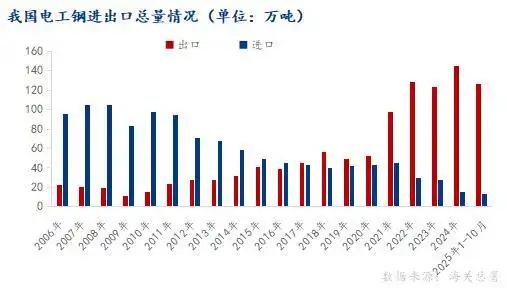
The total export volume of silicon steel in China has been continuously increasing in recent years. It is not difficult to see from the trend of China’s silicon steel import and export volume that the import volume of silicon steel in China has been decreasing year by year, while the export volume has been increasing year by year. Before 2017, the net export volume of silicon steel in China was negative, but since 2017, the net export volume has been positive, especially in 2021, when the total export volume saw a leap in growth. Data shows that the total export volume was 977,600 tons in 2021, 1,287,500 tons in 2022, 1,231,400 tons in 2023, 1,447,200 tons in 2024, and is estimated to be 1,550,000 tons in 2025.
From the perspective of exporting countries, the top exporters in the past two years have been India, Mexico, Italy, Vietnam, Turkey, Brazil, South Korea, the United States, and the United Arab Emirates, among others.
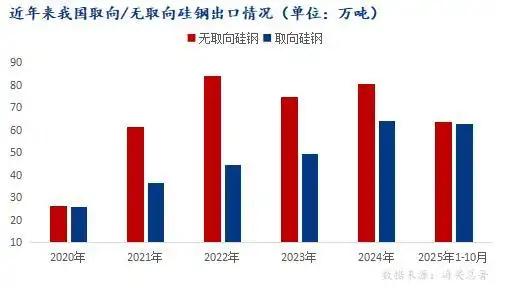
There is still a significant disparity in the export volumes of oriented and non-oriented silicon steel, with oriented silicon steel being overly dependent on exports.
According to statistics, in 2024, China’s total exports of non-oriented silicon steel were 805,200 tons, and those of oriented silicon steel were 642,500 tons, representing year-on-year growth of 7.8% and 29.85% respectively. From January to October 2025, China’s cumulative exports of non-oriented silicon steel were 637,300 tons, and those of oriented silicon steel were 628,800 tons, showing a year-on-year decline of 3.79% and an increase of 14.93% respectively. In terms of imports, China’s total silicon steel imports in 2024 were 148,900 tons, and from January to October 2025, they were 135,000 tons, among which non-oriented silicon steel imports were 51,500 tons and oriented silicon steel imports were 83,500 tons. It is evident from the latest export data of non-oriented and oriented silicon steel that their volumes are almost equal, while the supply of non-oriented silicon steel is nearly five times that of oriented silicon steel. This indicates that there is still a significant disparity in their foreign trade volumes, and it is clear that oriented silicon steel is overly dependent on direct exports.
According to relevant research data, China’s exports of non-oriented silicon steel account for about 6% of its production, while those of oriented silicon steel account for about 20%. Looking at the export proportions of other cold-rolled steel products, cold-rolled steel accounts for about 9%, galvanized steel about 27%, color-coated steel about 30%, and tinplate about 35% or more. Compared with the export proportions of other steel downstream derivatives, the export proportion of silicon steel varieties is relatively low. The reasons for the disparity between oriented and non-oriented silicon steel exports are mainly as follows:

Fluctuations in global market demand and intensified competition.
The international demand for non-oriented silicon steel is significantly influenced by the global economic cycle. For instance, in 2023, the global export volume of non-oriented silicon steel dropped by 11.39% year-on-year to 747,000 tons, partly due to the sluggish demand in downstream industries such as motor manufacturing, where purchases were made on a just-in-time basis, thereby curbing export growth. Meanwhile, China is facing competition from traditional silicon steel producers like Japan and South Korea, which have technological advantages in high-end grades, thus limiting China’s share of the international market.
Excessive domestic capacity growth and price pressure.
In recent years, China’s capacity for non-oriented silicon steel has continued to increase, with new production lines expanding supply. Since 2023, domestic prices of non-oriented silicon steel have shown a volatile but stable trend. The oversupply situation has led enterprises to prioritize the domestic market. From January to October 2025, the cumulative export volume declined by 3.79% year-on-year, reflecting the pressure to balance capacity release and domestic demand absorption. The downward trend in prices has also weakened export competitiveness, and since 2012, China has been subject to anti-dumping measures by countries like Brazil and India, further affecting its exports. In contrast, the domestic price of oriented silicon steel HIB has dropped significantly this year, while the price in Europe and the United States is more than twice as high, giving China an advantage in exports.
Overseas industrial chain layout and downstream industry transfer.
The export destinations of non-oriented silicon steel are highly concentrated. For instance, markets like Vietnam and the United States have demand, but are affected by local production or trade policies. In 2024, the export volume to Vietnam was approximately 88,000 tons, a year-on-year increase of nearly 40%, but the overall share remains limited. It is known that some domestic downstream motor enterprises have gradually moved overseas to countries such as Thailand, Vietnam, and Malaysia. As a result, China’s direct exports of non-oriented silicon steel have gradually shifted to semi-finished assembly parts (such as laminations, stators, and rotors), which has indirectly reduced direct exports of non-oriented silicon steel. Please provide the text you would like translated.